
In the heart of modern industrial operations, automation cabinets (also known as control panels or electrical enclosures) are the mission-critical hubs that translate complex software commands into precise physical actions. These assemblies house the sensitive PLCs, variable speed drives (VFDs), and safety systems that power everything from conveyor belts to robotic assembly lines.
Navigating the lifecycle of an automation cabinet—from the initial conceptual design to a powered-on, functional installation—requires technical expertise, adherence to stringent safety standards, and logistical precision.
Our comprehensive automation cabinet services streamline this entire journey, offering a single point of responsibility for hardware selection, quality-assured manufacturing, reliable delivery, and expert onsite installation.
The Architecture of Efficiency: Precise Equipment Selection
The foundation of a reliable automation cabinet is a robust electrical design. But the design is only as strong as the components specified within it. Equipment selection is the crucial first step where engineering knowledge meets practical application.
Our process ensures that the components selected—such as Allen-Bradley PLCs, Siemens VFDs, or Eaton switchgear—are not only compatible with your system requirements but are also optimal for efficiency, future scalability, and the operational environment.
During this phase, we focus on several key factors:
-
Environmental Rating: Determining if the cabinet requires a NEMA 4X (corrosion resistant) rating or standard IP54 protection based on its intended location.
-
Thermal Management: Calculating heat dissipation for active components like drives and adding the appropriate cooling systems (fans, heat exchangers, or air conditioning).
-
Component Specification: Customizing hardware based on your preferred vendors and performance needs (e.g., standard vs. safety-rated PLCs).
The Role of Eplan in Component Strategy
To ensure precision during equipment selection, we utilize advanced CAE tools like Eplan Electric P8. We use this data-driven software to create the "Digital Twin" of your electrical system.
This allows for immediate generation of accurate Bills of Materials (BOM), verification of logical connections, and standardized component naming conventions, significantly reducing the risk of errors before manufacturing even begins.
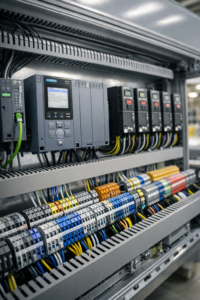
A view inside a newly assembled automation cabinet, showcasing a Siemens PLC, compact drives, and meticulous organization.
Bringing the Blueprint to Life: High-Quality Manufacturing
Once the design is finalized and the optimal components are selected, the project moves into the manufacturing phase. This is where engineering drawings are translated into physical hardware. Our manufacturing process prioritizes cleanliness, safety, and rigorous documentation.
Our technicians follow a standardized workflow:
-
Mechanical Preparation: The enclosure is modified with precision cutouts for HMIs, ventilation fans, and cable glands.
-
Component Mounting: PLCs, contactors, drives, and terminal strips are DIN-rail mounted according to the spatial layout designed in the engineering phase.
-
Meticulous Wiring: Every wire is sized correctly, crimped with high-quality ferrules, and labeled at both ends. This labeling matches the schematics precisely, ensuring ease of maintenance for the life of the machine.
Rigorous Testing and Quality Assurance
Manufacturing isn’t complete until the cabinet passes our internal quality gate. Our standard testing procedure includes:
-
Point-to-Point Wiring Check: Verifying that every wire connects to the correct terminal.
-
Power-On & Logic Testing: Applying control voltage to the PLC and verifying correct I/O functionality and basic communication integrity.
The Last Mile: Strategic Delivery and Installation
The final phase of our automation cabinet service involves transitioning the completed unit from our facility to yours. A seamless delivery and a correct onsite installation are critical to project success and equipment longevity.
Secure Transportation
Automation cabinets contain sensitive electronics that do not tolerate excessive vibration or shock. We utilize specialized logistics partners who understand the requirements of industrial automation equipment. Our units are strategically packed, shrink-wrapped, and shipped using air-ride suspension vehicles to minimize the risk of transit damage.
Expert Onsite Installation
Once the cabinet arrives at your site, our expert field service team takes over. The installation process is methodical and focuses on safety and integration:
-
Rigging & Positioning: The enclosure is moved into its final location, ensuring adequate clearance for maintenance and compliance with local safety codes.
-
Primary Field Connections: We connect the main incoming power feed and establish critical grounding.
-
Field Device Integration: Our team executes the field wiring, connecting sensor cables, motor leads, and communication lines from the machines to the cabinet's terminal strips, all while referencing the original Eplan documentation.
-
SAT (Site Acceptance Test): We perform a powered-on validation of all field connections and basic cabinet functionality before handing the system over for commissioning.
A Unified Partner for Automation Excellence
By choosing a single provider for the entire automation cabinet lifecycle, you eliminate communication gaps between engineering and assembly. This integrated approach ensures that the component selected during design is exactly the component that arrives onsite, correctly wired, and ready to optimize your production.